Definite integrals: signed area and reversed bounds
5-minute read · 7 sections
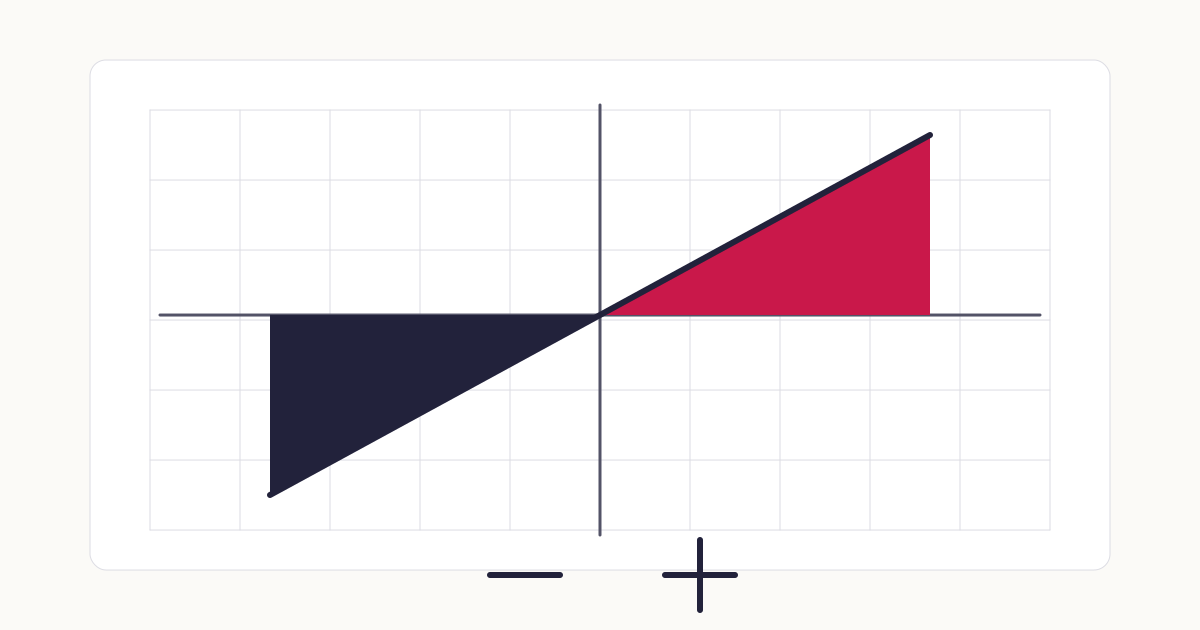
A curve can enclose two visible regions while its definite integral is zero. Before trying another integration rule, check which kind of area you meant to calculate. The number may already be correct.
A region has a size; an integral also has a sign
For bounds that run from left to right, a positive function contributes positively to the integral and a negative function contributes negatively. Geometric area adds the sizes of both kinds of regions. I say “signed integral” when discussing the first number and “geometric area” when discussing the second, because the single word area hides the distinction that causes most confusion.
Mathematically, geometric area over a finite interval is the integral of abs(f(x)), with the interval taken from its smaller endpoint to its larger endpoint. It is never negative. The signed value depends on the original orientation. Neither result is automatically the answer to a practical question: a displacement question and a distance question, for example, interpret positive and negative velocities differently.
Calculate the two triangles separately
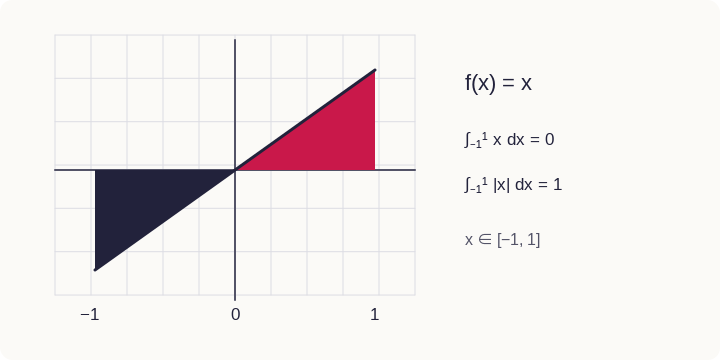
Take f(x) = x from −1 to 1. An antiderivative is F(x) = x^2/2. At the right endpoint, F(1) = 1/2. At the left endpoint, F(−1) = 1/2. Subtracting gives 1/2 − 1/2 = 0. Those equal endpoint values establish the net result when the ordinary evaluation theorem applies.
The drawing tells another useful story. On [−1,0], the graph lies below the axis and forms a triangle with base 1 and height 1. Its signed contribution is −1/2. On [0,1], the same dimensions give +1/2. Add the contributions to get zero; add their absolute sizes to get 1. No region has disappeared merely because the signs cancel.
| Interval | Signed contribution | Geometric size |
|---|---|---|
| −1 to 0 | −0.5 | 0.5 |
| 0 to 1 | 0.5 | 0.5 |
| −1 to 1 | 0 | 1 |
Reverse the bounds without redrawing the function
For x^2 from 0 to 3, F(x) = x^3/3 gives F(3) − F(0) = 9. Reversing the interval gives F(0) − F(3) = −9. The graph still lies above the axis. The negative number comes from the order of the endpoints, not from a new negative patch of the curve.
This is why I read both bounds aloud before interpreting a result. “From three to zero” asks for the opposite directed accumulation to “from zero to three.” The geometric area of the region remains 9 either way. A graph that sorts the endpoints for display must therefore keep the original direction in a separate explanation; the calculator does this beside the result.
Find crossings before adding geometric area
For f(x) = x − 2 over [0,3], the sign changes at x = 2. The lower triangle has base 2 and height 2, giving size 2 and signed contribution −2. The upper triangle has base 1 and height 1, giving size 1/2 and signed contribution +1/2. The signed integral is −3/2; geometric area is 5/2.
You can also use F(x) = x^2/2 − 2x. Its endpoint values are F(3) = 9/2 − 6 = −3/2 and F(0) = 0. Their difference matches the signed result. To obtain geometric area by hand, split at the crossing and reverse the sign of the contribution below the axis. Taking the absolute value of the final net result would give 3/2, which loses the cancellation and is wrong for geometric area.
An average value is another calculation
The average value of a function over an increasing interval [a,b] is its signed integral divided by b − a. For x^2 on [0,3], the integral is 9 and the width is 3, so the average value is 3. Its units match the function’s output, whereas the integral multiplies those units by the units of the variable.
Do not apply this quotient to a zero-width interval, because its denominator would be zero. Also distinguish the average function value from the average of sampled graph heights. A few uniformly spaced readings are an approximation that can weight the curve differently from exact integration. The current calculator displays signed and geometric area; it does not label either one an average.
A finite endpoint difference needs a valid interval
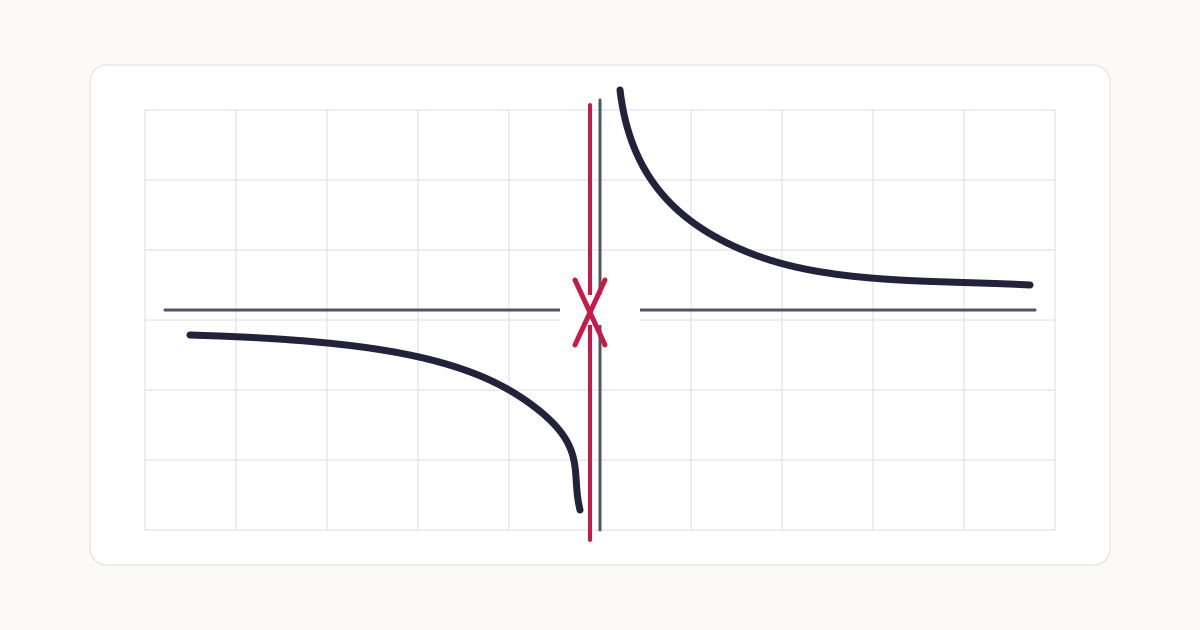
The function 1/x is the important counterexample to careless subtraction. Over [−1,1], the expression ln(abs(x)) gives zero at both endpoints. Nevertheless, the integrand has an infinite discontinuity at zero. The ordinary endpoint calculation does not establish an integral across that point.
OpenStax distinguishes this situation in its treatment of improper integrals: the separate one-sided integrals at an interior infinite discontinuity must converge. A symmetric cancellation sometimes discussed as a principal value is a different operation. I never silently replace an ordinary integral with that operation to obtain a convenient zero.
Check a result in an order that catches sign mistakes
- Write the expression and bounds exactly, keeping the endpoint order.
- Inspect the real domain throughout the interval before using an antiderivative.
- Calculate F(b) and F(a) separately, then subtract in that order.
- Locate crossings if you need geometric area rather than net accumulation.
- Compare the sign and rough scale with the graph, without treating samples as a proof.
Try the same examples in the integral calculator. It shades positive and negative regions, keeps bound direction visible and labels numerical estimates. For the next stage, read about choosing an integration method or the limits of domain screening and numerical checks. Correct arithmetic, a valid interval and the right interpretation are three separate requirements.
Questions and answers
Does zero signed area mean zero geometric area?
No. Equal positive and negative contributions can cancel while their geometric sizes add.
Why is x^2 negative when I reverse the bounds?
The endpoint subtraction changes from F(b) − F(a) to F(a) − F(b). The curve’s geometric area is unchanged.
Can I take the absolute value of the final integral for area?
Only if the curve does not change sign on the interval. Otherwise integrate the absolute value or split at each crossing.